Spoiler Warning: Don't read this if you haven't yet read "A Clockwork Orange."
Other than setting the tone and giving a bleak description of society, I had no idea what the heck this book was actually about until recently. Up until this week, the entire book consisted of random acts of "ultra-violence" described with exact precision so the reader can get a vivid and often disturbing image in his head. So what were Burgess's intentions for all of this violence in the first half of the book? Well, as sick as it may sound, that made the book very intriguing. As Edward Tanguay says in his
review of the novel, "The reader is shocked and upset and wants some kind of explanation, wants to see the reasons for this violence. You wait for Alex or some of his friends to show some kind of repugnance towards the violence they are committing, but they do not. It is all out violence with no moral significance attached." (Tanguay, 1996). The book, has however, picked up quite a bit; there's been a shocking twist in the novel, and our once violent Alex is now docile as ever. This drug-induced kindness is a result of an experimental process called the Ludovico Technique, implemented by the government to "cure" criminals of their horrific behavior. It's only once I hit this point in the novel that I realized what the title meant.
"Clockwork" implies the mechanical, robot-like submission of the main character after the government uses a combination of drugs and movies to make him allergic to his own violent tendencies. Every time Alex even imagines a violent act, the drug that flows through his veins automatically sickens him. He is no longer capable of making an ethical decision; the drug influences his every action. At first I thought that the "orange" was perhaps because often prisoners will wear orange jumpsuits and seeing as how Alex was a prisoner, it would make sense. No, not at all. Way too much of a stretch. The "orange" component actually comes from an old English expression: "as queer as a clockwork orange," meaning crazy. According to
this article from Yahoo, many have interpreted that "the title craftily blends the automatic (clockwork) with the organic (orange), which is appropriate considering the profoundly screwed up mind of the main character, Alex" (Yahoo, 2005).
This story reminded me of "1984" seeing as how they're both stories of unruly people getting "straightened out" by the government. This book's been great and I'm really upset that within a few chapters it'll be over. But I will definitely read it again sometime and I know this is kind of a pointless statement considering the very first thing I said in this post, but for those of you haven't read this brilliant novel, I suggest you do. You won't regret it.
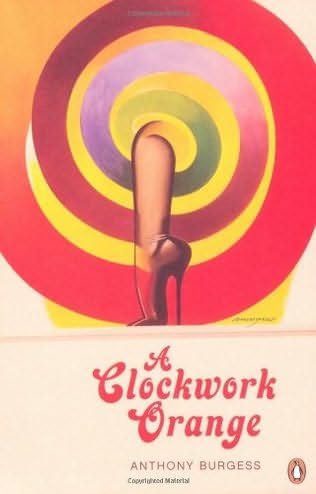
 Last week, I officially finished reading "A Clockwork Orange." I loved it. It's with my distinct pleasure to award it the title of "First novel in years to actually hold my interest from cover to cover." Kind of an awkwardly long title for an award. But that's exactly what "A Clockwork Orange" did. It held my interest and that's quite a triumph for any book.


