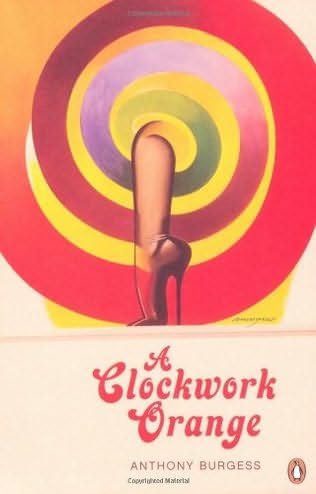
A Clockwork Orange
Tuesday, May 20, 2008

Monday, May 12, 2008
Final week for the essay...
Monday, May 5, 2008
This week...
Monday Night: Read.
Tuesday: AP Exam. Read.
Wednesday: Begin Research Paper. Read.
Thursday: Class wiki. Continue Research Paper. Continue reading.
Friday: Have at least an introductory paragraph. Finish Brave New World.
Monday, April 28, 2008
This week:
-Continue reading Brave New World
-Brainstorm ideas for the research paper
-Find criticisms to support these ideas
-If I'm far enough into Brave New World, I will begin writing the paper. If not, next week I will be.
Monday, April 14, 2008
4th Marking Period Project: Utopian and Dystopian Fiction
That's a basic prototype for the entire marking period. Along the way, ideas will be added and changed.
But for this week I plan to:
-Find an interesting novel to read that depicts a Utopia. With the help of a list that I found on wikipedia, this shouldn't be too hard.
-Scanning the internet for external sources and criticisms that could help bring about ideas for a research paper.
-Brainstorming historical governments and events that might be relevant to the content I'm studying.
-Immediately begin reading the book that I decide on.
Questions I have yet to answer:
-What percentage of the total work should be focused on the already studied dystopian fiction?
-What should be the first novel I start with?
Friday, March 28, 2008
Cultural Differences leading to Violence

It seems like with each passing day there is an exponential increase in reports of global terrorism and acts of violence in the name of one god or another. Hezbollah rockets falling into Israel, world-wide suicide bombings, the Janjaweed performing mass genocide in Sudan, Arab factions obliterating each other in civil war. These are only a few examples; the list goes on and on. With the way the world is going nowadays, global warming doesn't concern me. If there's anything bringing mankind closer and closer to it's demise, it's all of the hatred and intolerance.
It's not just today though. Terrorism dates back to biblical times; this kind of stuff has been going for years. The Crusades, the Holocaust, the mass genocide in Rwanda to name a few. Even our own country was founded on the very same principle we're talking down today: intolerance. The simple fact is we did not accept native American culture. We converted them, killed them, and took the land.
All of this ties into a theme captured in Things Fall Apart. Tensions build as the white colonialists begin converting the tribes of Umuofia to Christianity. Some accept this new set of beliefs. Others, such as Okonkwo, are outraged and rebel, leading to a church burning, a couple tribesmen getting beaten and insulted, and a missionary getting murdered. Obviously all of the horrible things listed in the above paragraphs are on a much greater scale, but the idea is the same. People are intolerant of each other's differences.
I think a portion of it is simply human nature. Competition is natural and it's understandable for similiar people to band together. Intolerance and hatred, however, are caused by corrupt and power-hungry leaders. Normal human beings are passive and try to avoid fighting. Genocide and war occurs when people are brainwashed. The situation seen in Things Fall Apart shows a sort of brainwash as well. The white colonialists are ignorant and think that their customs are superior to those of the African tribes, when they aren't: they're just different.
Sunday, March 23, 2008
Gender Inequality

It didn't shock me when I first began seeing the crystal-clear gender inequalities that sprang up in Things Fall Apart. This isn't so baffling, considering the tribal culture and time period. Fortunately for women, opportunities and privileges are much more abundant nowadays. In America that is. Many cultures still persecute women. But speaking specifically of this country, women have come a long way. In fact, years ago a female candidate in the presidential election would be unheard of. There's still one issue however...
According to recent studies, there's still "gender wage gap" that exists in America, which basically translates into women working similar hours and getting paid a fraction of a man's salary. "A close look at the earnings of women and men who work 40 hours or more per week reveals that the wage gap may actually widen as the number of hours worked increases. Women working 41 to 44 hours per week earn 84.6% of what men working similar hours earn; women working more than 60 hours per week earn only 78.3% of what men in the same time category earn." (Lips, 2008). Bizarre circumstances for a country based on equality. This gap is greatest among whites, though still exists for other races.
This is unfortunate, but a huge improvement compared to how it used to be. Women used to be treated the way they are in Things Fall Apart and still are in some countries. Okonkwo's only relation to woman is within his three wife polygamy, in which beatings and disrespect are quite common. This source explains that "The world in Things Fall Apart is one in which patriarchy intrudes oppressively into every sphere of existence. It is an androcentric world where the man is everything and the woman nothing...Achebe's sexist attitude is unabashed and without apology. (Mezu)" ('Metacognizant', 2001). Women used to stay at home, cook, clean, and look after children, but there's been a huge increase of women in the workplace. "According to the Bureau of Labor Statistics, white men (who once dominated the workplace) now account for about 45percent of all workers. White women and women of color make up 47 percent ofthe workplace. In 1995, 76 percent of women between the ages of 25 and 54 worked outside the home, up from 50 percent in 1970." (Net Industries, 2007).
There's no definite sign that the gender wage gap will be thinning to a close any time soon. However, based on Hillary Clinton running for president and the surge in women joining the workforce, I'd say it's possible and probable. I hope the gap closes because this country is supposed to be characteristic of awarding people based on the effort they put forth. Not race, age, gender, religion, etc.
Friday, March 14, 2008

A principal driving force behind the writing of Things Fall Apart, by Chinua Achebe is the common stereotype that African culture is "primitive." The following website explains a lot about Achebe's thoughts and reasoning for the novel. Some of the first characteristics we see in the small village of Umuofia is the strict day-to-day protocol and deeply profound traditions. The dialogue is rich and and expressive, unlike the African literature written by Europeans, which criticized and berated their culture. "The language of the novel is simple but dignified. When the characters speak, they use an elevated diction which is meant to convey the sense of Ibo speech. This choice of language was a brilliant and innovative stroke, given that most earlier writers had relegated African characters to pidgin or inarticulate gibberish. One has the sense of listening to another tongue, one with a rich and valuable tradition." (Brians, 1994).
It's evident from the very beginning that the tribes have more honesty and greater values than their European colonizers. For instance, like I said in my last post, Okonkwo began life poor. He had no titles or Because he was a hard worker, he managed to succeed in life. The wealthy man that he borrowed from to get his life started gladly supported him, regardless of how irresponsible and unethical his father had been. The point Achebe was making is that in this Nigerian society, people are judged by who they truly are. Not by their ancestry or titles. It gives the poor a chance to make it in life. The European colonists, on the other hand, came from a land with strict social classes that lacked flexibility. Back in Europe at this time, if a person was rich, it's because they were born into it. The impoverished majority remained poor while the slim percentile of rich folk had a tight grip on the power.
I can understand Achebe's anger and frustration. "As a young boy the "African literature" he was taught consisted entirely of works by Europeans about Africa, such as Conrad's Heart of Darkness and Joyce Cary's Mister Johnson, which portrays a comic African who slavishly adores his white colonist boss, to the point of gladly being shot to death by him. Achebe has said that it was his indignation at this latter novel that inspired the writing of Things Fall Apart. He also wrote a famous attack on the racism of Heart of Darkness which continues to be the subject of heated debate." (Brians, 1994). I 100% agree with Achebe's reaction. The European colonizers were power hungry, arrogant, and narcissistic . They viewed themselves as the superior race and tried to suppress African culture. Sounds a lot like Nazi Germany.
Chinua Achebe not only wrote this novel to enlighten the ignorant, but also bring hope back to his own people. "All too many Africans in his time were ready to accept the European judgment that Africa had no history or culture worth considering." (Brians, 1994). I find this statement incredible. It's almost as if European influence was so strong that it had a brainwash effect or something. Kinda scary to think about.
Sunday, March 9, 2008
The factors of success

A huge theme in Things Fall Apart is the concept of success. What makes a man successful? How does one measure success? Okonkwo, the main character of the novel, inherited only one legacy from his father: a disadvantaged life in poverty. His lazy, irresponsible father died in debt, leaving him nothing but embarrassment, shame, and a burning hate for everything his father stood for. He embodies the driving force necessary for Okonkwo to make it in life. The main character works hard and fights starvation, trying to provide for himself. He eventually succeeds in obtaining two respectable village titles and a massive estate for him and his three wives.
From what I’ve read so far, this novel is a criticism of the negligent; it defines success as the result of years upon years of hard work and unwavering discipline. According to the triumphant Okonkwo, success is achieved through facing one’s problems head on and never flinching or backing down or showing weakness. Ever. That’s a pretty extreme way of looking at things. Then again, he is a high ranking member of a barbaric African tribe. Let me try to reshape the definition of success into one more compatible with society today.
I read up on some of the factors that make a typical man of today successful. Based on this article, it seems that the most important step to success is conquering the natural human desire to be passive and let things “fall into place.” “I cannot overstress the importance of beginning the great work of being proactive rather than reactive in life. Accept these facts: Life is a difficult battle, demanding conflict and struggle. The best way to meet this requirement is by taking the battle to life, not letting life take the battle to you.” (Coughlin, 2008). Now obviously, this doesn’t mean cutting heads and claiming women as wives left and right like Okonkwo did, but with all the job competition and the capitalist mentality of
Thursday, February 28, 2008
 Last week, I officially finished reading "A Clockwork Orange." I loved it. It's with my distinct pleasure to award it the title of "First novel in years to actually hold my interest from cover to cover." Kind of an awkwardly long title for an award. But that's exactly what "A Clockwork Orange" did. It held my interest and that's quite a triumph for any book.
Oh well, goodbye Clockwork =( , hello new book. =)
Friday, February 15, 2008
Other than setting the tone and giving a bleak description of society, I had no idea what the heck this book was actually about until recently. Up until this week, the entire book consisted of random acts of "ultra-violence" described with exact precision so the reader can get a vivid and often disturbing image in his head. So what were Burgess's intentions for all of this violence in the first half of the book? Well, as sick as it may sound, that made the book very intriguing. As Edward Tanguay says in his review of the novel, "The reader is shocked and upset and wants some kind of explanation, wants to see the reasons for this violence. You wait for Alex or some of his friends to show some kind of repugnance towards the violence they are committing, but they do not. It is all out violence with no moral significance attached." (Tanguay, 1996). The book, has however, picked up quite a bit; there's been a shocking twist in the novel, and our once violent Alex is now docile as ever. This drug-induced kindness is a result of an experimental process called the Ludovico Technique, implemented by the government to "cure" criminals of their horrific behavior. It's only once I hit this point in the novel that I realized what the title meant.
"Clockwork" implies the mechanical, robot-like submission of the main character after the government uses a combination of drugs and movies to make him allergic to his own violent tendencies. Every time Alex even imagines a violent act, the drug that flows through his veins automatically sickens him. He is no longer capable of making an ethical decision; the drug influences his every action. At first I thought that the "orange" was perhaps because often prisoners will wear orange jumpsuits and seeing as how Alex was a prisoner, it would make sense. No, not at all. Way too much of a stretch. The "orange" component actually comes from an old English expression: "as queer as a clockwork orange," meaning crazy. According to this article from Yahoo, many have interpreted that "the title craftily blends the automatic (clockwork) with the organic (orange), which is appropriate considering the profoundly screwed up mind of the main character, Alex" (Yahoo, 2005).
This story reminded me of "1984" seeing as how they're both stories of unruly people getting "straightened out" by the government. This book's been great and I'm really upset that within a few chapters it'll be over. But I will definitely read it again sometime and I know this is kind of a pointless statement considering the very first thing I said in this post, but for those of you haven't read this brilliant novel, I suggest you do. You won't regret it.
Tuesday, February 5, 2008
The Bizarre Language of "Nadsat"
However, the uniqueness wasn't his only reason for using the alien jargon; Burgess wrote this story during the 1960s, a time when the United States and the U.S.S.R. were becoming superpowers. A majority of the bizarre words are taken from the Russian language and slightly tweaked to create a fictional language called "Nadsat." Russia's influence on the world during the time this book was written is shown clearly in the language spoken by characters.


